
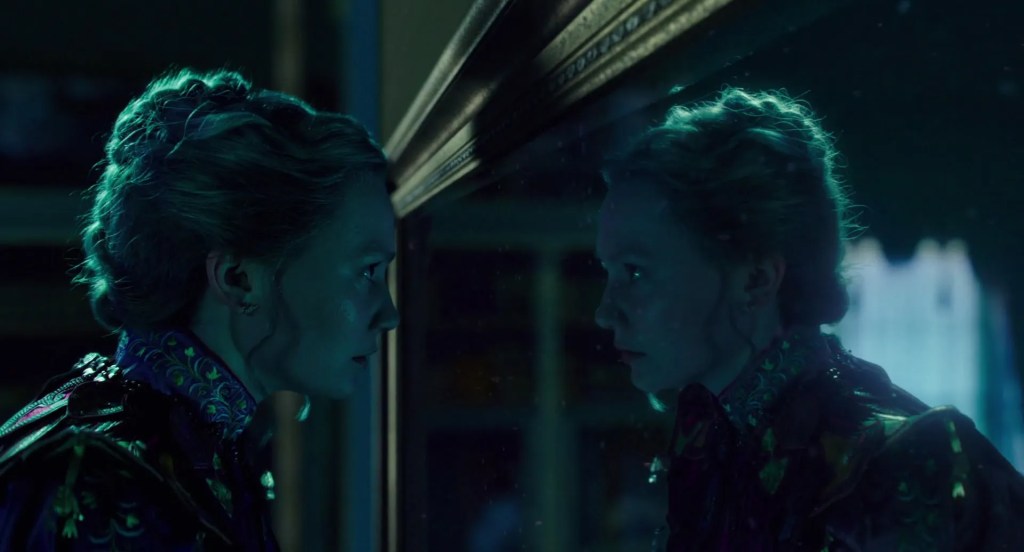
In Alice Doesn’t, Teresa De Lauretis examines semiotics and narrativity in cinema, reconfiguring psychoanalysis — specifically Freud’s concept of identification and Oedipal narrative codes — through an anti-idealist lens. Engaging with Mulvey’s gaze theory, she reinvestigates “women’s consent” in relation to narrative cinema’s role in “seducing the woman into femininity”. De Lauretis qualifies Mulvey’s initial bifurcation of the gaze as either masculine or feminine by drawing on Lacan’s omission of sexual difference in adult spectators. She argues that while masculinity and cinematic identification are possible in the viewing process, they are not inextricably linked. The female spectator’s gaze is neither wholly masculine nor feminine but operates through a “double identification” with the figure of narrative movement. This figure enables what De Lauretis calls “figural identification”, in which the spectator simultaneously identifies with both the gaze and the image, anchoring them within the film’s movement. She describes this as a “narrative pressure” that directs identification, working in tandem with the reality that spectators are already “engendered” by “historically and socially constituted subjectivity”.
This framework critiques the notion that female subjectivity is entirely shaped by cinema’s coercion into a “primitive, primary, or purely imagistic identification”. Instead, by recognizing that spectators primarily identify with narrative, De Lauretis deconstructs narrativity itself as being shaped by Oedipal codes of pleasure and desire. She asserts that it is not Oedipal pleasure that suppresses feminine pleasure, but rather the theoretical recapitulation of myth that has silenced the Sphinx — the feminine. Furthermore, De Lauretis reminds readers that narrative, as is evidenced by Oedipal codes, is a product of historical determinations, stripping it of its assumed natural trajectory. This realization empowers feminist films theorists to restructure existing frameworks rather than wholly rejecting psychoanalysis for its omissions and blind spots. As she puts it, feminist theory can embrace “the reappropriation of what can be intellectually and politically useful for feminism”. This approach recalls Agnes Varda’s re-appropriation of popular and mainstream aesthetics, as well as her integration of the masculine within her cinematic world — not to reinforce dominant structures but to conjure dialectics through a primacy of the feminine.
Works Cited
De Lauretis, Teresa (1984). Alice Doesn’t: Feminism, Semiotics, Cinema. Indiana University Press (Ips).
Creekmuir, Corey K. Film Quarterly 40, no. 1 (1986): 48–50. https://doi.org/10.2307/1212313.

 Jenn Thảo Nguyễn
Leave a reply to lookmyblogs Cancel reply