Cinema, Migration & Diaspora
An archive of my ‘Cinema, Migration & Diaspora’ Course Discussion
-

Mississippi Masala (Week 7)
One striking aspect of our observations of Mira Nair’s Mississippi Masala – in conversation with Appiah’s monograph, Bose and Varghese’s article, and Mehta’s writing – is the question of how individuals construct their identities and subjectivities. This process of self-definition depends on clear boundaries: between the individual and the community, and between the community and…
-

Past Lives (Week 5)
Upon reading our article on Fredric Jameson’s notion of postmodernism in connection with Celine Song’s Past Lives, it occurred to me that there may be two distinct ways one might practice hermeneutics on this contemporary text. The first, and perhaps most obvious, is that which Megan Feeney undertakes in her Cineaste review of Song’s film…
-

A Touch of Sin (Week 4)
When discussing animal imagery in Jia Zhangke’s A Touch of Sin, an abundance of references come to mind: Dahai’s tiger quilt, San’er’s interaction with three oxen on the back of a truck, a snake crossing Xiao Yu’s path, and Lian Rong presenting Xiao Hui with the plastic bag of goldfish. The proliferation of such imagery…
-
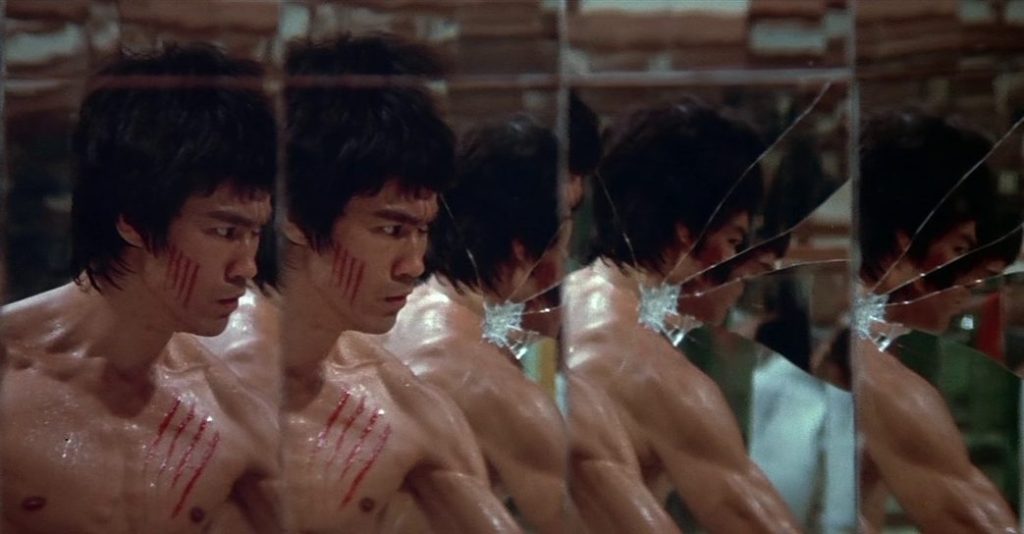
Enter the Dragon (Week 3)
[excerpt from in-class Midterm] In Robert Clouse’s Enter the Dragon, Bruce Lee’s role as the enigmatic protagonist “Lee” closely mirrors his public persona. His success in the film industry stems from his unique upbringing as both a child actor in Hong Kong cinema and a performer on American television. The combination of these experiences allowed Lee…
-

Bauhinia (Week 2)
[excerpt from in-class Midterm] Evans Chan’s Bauhinia, while also examining diasporic existence between Hong Kong and the United States, occupies a distinct position within De Man’s cinematic taxonomies and can thus be considered diasporic on its own terms. Commissioned as part of a 10-episode drama series by Radio Television Hong Kong (RTHK), Chan based his contribution…
-
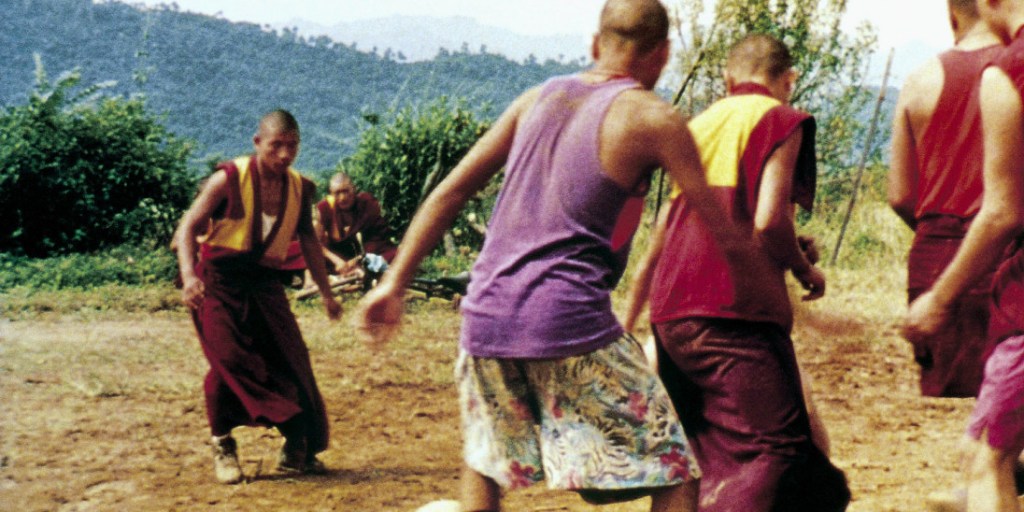
The Cup (Week 1)
Buddhist culture, as understood through our reading of Pema Tseden’s filmography and mode of production, is inextricably linked to Tibetan culture – an association that becomes especially intriguing when we consider Tseden’s intention to construct a “New Tibetan Cinema”. This emerging oeuvre, which includes Khyentse Norbu’s film The Cup, encourages Tibetan filmmakers to cinematically articulate…
 Jenn Thảo Nguyễn