
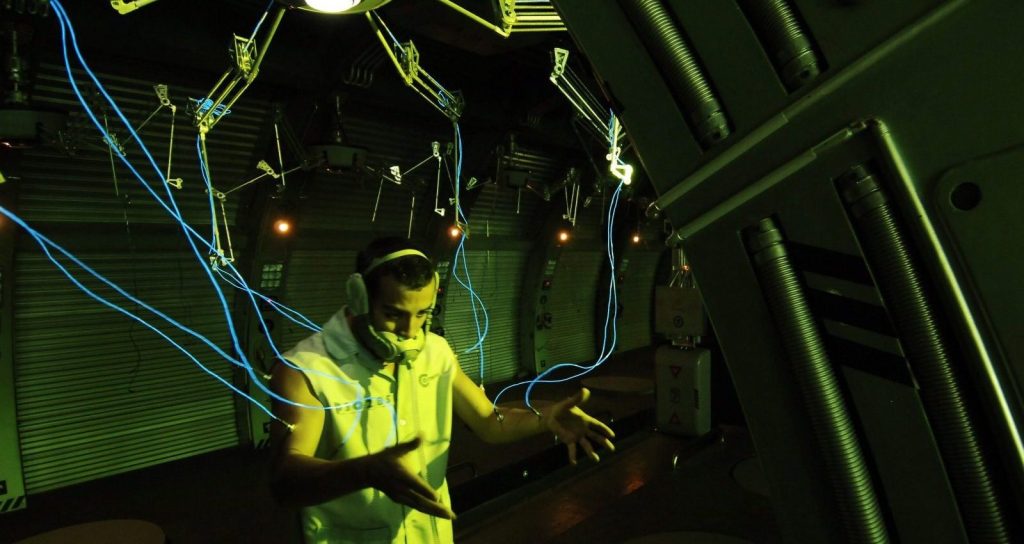
“A future with a past” serves as the thematic foundation of Alex Rivera’s border science fiction (SF) film Sleep Dealer (2008), a theme that underscores Wells’ analysis of the film’s evocative symbolism of the node and its scar. Through her discussion, Wells reveals how border SF, exemplified by Sleep Dealer, articulates the paradoxes between unilateral interpretations of the modern and postmodern, the mobility of capitalism versus immobility of the laborer, the local and the global, and the physical ruins of a border in contrast with cyberspace’s promised borderlessness. Notably, Chapter 8 of E&H’s Film Theory grapples with film theorists’ transition into the digital paradigm, a crossing-over that marks its own form of border negotiation — one that demands the mutual constitution of cinema’s past and future.
One point of note that struck me as having the potential to further strengthen Wells’ argument, regarding the horizontalization of space — and thus hierarchy — within border SF, is the acknowledgement of the geographic relationship between the U.S. and Mexico. Cartography, as an institutionalized rendering of the world, inherently positions the Global South in a gaze directed upward toward the Global North. Had Wells engaged with this notion, she might have reinforced her argument that border SF’s employment of geographic realism is more effective in exposing endemic hierarchies than hyperbolic depictions of striation, such as the dual planetary model in Elysium (Blomkamp, 2013). This formal restraint within border SF uniquely enables the subgenre to craft “new maps of hope” — a process of reckoning with a factual past as a means of hypothesizing a more hopeful future.
Similarly, E&H’s chapter on the “Digital Body” introduces the concept of remediation which locates a phenomenon of “change inside-out” that equally utilizes its past to hypothesize its future. The concept describes how new media’s packaging often mimics its predecessor to ease consumers into novelty, suggesting that the old skin — both a ruin and a border — becomes reconstituted by its historicity (familiarity) and function (a Trojan horse for intervention) (204). The chapter’s discussion of tele-action’s “renewed importance of doing things with your hands” (213), as per the etymology of the term digital, further complicates notions of agency, passivity, and culpability. This is particularly visible through Sleep Dealer‘s node factories. The skin of the laboring machine functions as a necessary surrogate, and illusion, that obscures the manual labor embedded within cyberspace and geography. The film constructs a cinematic allegory that subverts change inside-out, instead exposing a paradoxical change outside-in — where increased digitization masks the human labor behind it, whilst also absolving its users of culpability and exploitation. The liminality between these two remediations suggest that even the human skin itself could be remediated, repurposed as a vehicle for digital intervention — an idea perhaps seen in E&H’s own utilization of the human senses and haptic abilities as an entry point for theoretical analysis of, and engagement with, this new cinematic paradigm.
 Jenn Thảo Nguyễn
Leave a comment