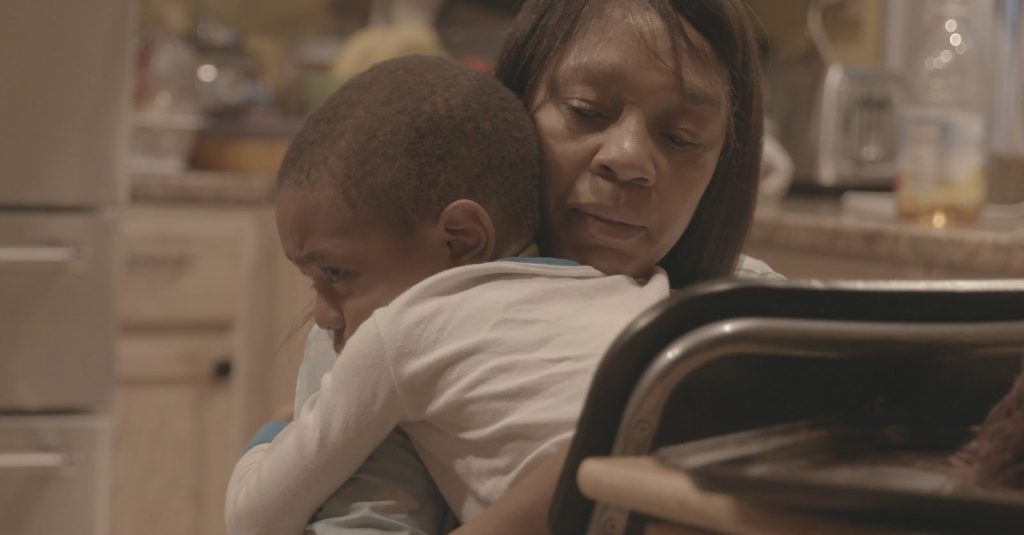
I feel that our discussions of publicness, in many ways, deeply connote visibility. Garbes writes of how, when we envision economies, the imagery typically aligns with places “covered by the media,” like Wall Street offices and factories. She then catalogs the various forms of intrinsically economic work — such as those in “laundry rooms, nurseries, done on hands and knees, sponge or toilet brush in hand” (56) — that remain unseen. I immediately think of Nunu in Loira Limbal’s Through The Night (2020), where she is often shown performing these tasks, even while engaging with the children. Surfaces are scrubbed, food is prepared — demonstrating how the documentary makes visible the foundational infrastructure of childcare that supports “business as usual”. Beyond simply seeking visibility for this work, the film also reveals the pain that surfaces from the “care economy”, a pain that may only be glimpsed fragmentarily due to deliberate efforts to keep it invisible.
The mothers come to Nunu’s care on the verge of exhaustion, having performed labor to support their accessibility to childcare. Though this labor is made “invisible” to the children, Dani’s statement, “I don’t want to grow up, I don’t want to pay bills… I just want to be a kid forever”, demonstrates how the weight of exasperation from the caregiver transmutes into fear and anxiety within the child. What cannot be seen is palpably felt. Later, when Dani returns to assist Nunu at the daycare center, this decision reveals the entrapment of the care economy in two main ways. First, it demonstrates how Dani must offer her own labor as a means of holding onto a vital safe space she can no longer freely access due to a lack of governmental subsidies, a space that took equal part in nurturing her. Second, Dani sees that those who have provided her care are weakening under the system, and in an effort to preserve these sources, she feels she must protect them with her care. Through both motivations, Dani, in effect, takes up a mantle that enables the commodification of her pain, becoming a laborer in the next generation of the care economy.
Another key thread in the film is Nunu’s regular visits to the “Pain Clinic”. Although this work is undoubtedly relieving, the clinic seems to embody Nadasen’s point that “pain and suffering are lucrative rather than unintended effects” (4). It speaks to the way clients focus on symptoms rather than addressing root causes, as they lack the luxury of self-care and, above all, time. Temporality is a privilege; laborers in the care economy are not afforded control of their time, and as such, it becomes clear why all of our readings discuss the revelation that came in the wake of the pandemic, with Through The Night’s apt release in 2020. When all were forced to calibrate to the same temporality, inequities in the care economy could no longer remain invisible, and the absence of its invisible workers was too palpably felt by the economy at large.
 Jenn Thảo Nguyễn
Leave a comment