
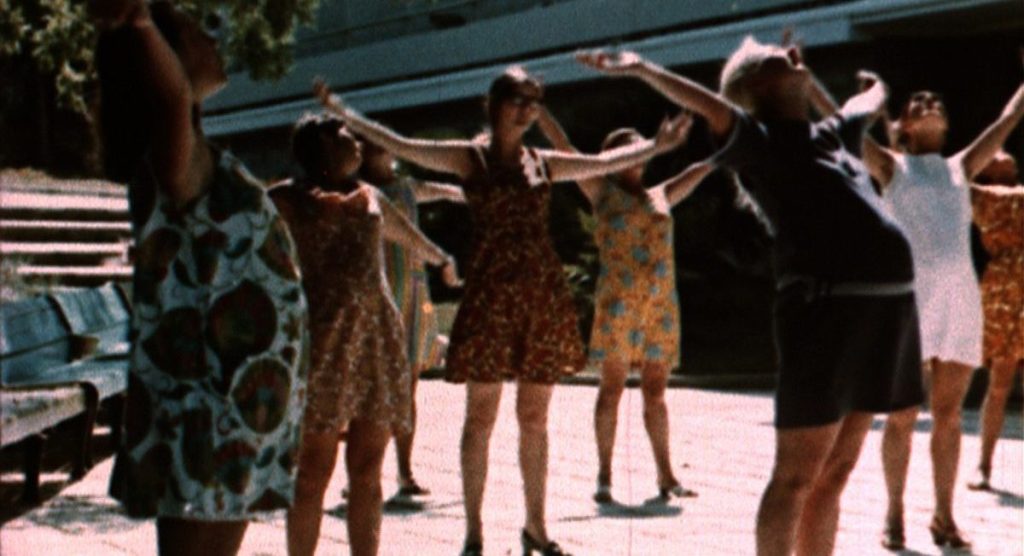
Our screening of Irene Lusztig’s The Motherhood Archives (2013) lingered with me in its dialectical use of visual and sonic montage. I could locate a feeling of suffocation that came from the tinny and “underwater”-like sounds accompanying both the celluloid footage and the eery advertisements for contemporary birthing facilities. Lusztig includes male narrations to emphasize the masculine presence controlling these mothers’ birth experience, but foils it with the breathy feminine voice — operating as our omniscient guide — which manufactured a claustrophobic feeling of hypnosis. I felt I was being subdued, and in response wanted to fight back from this feeling and return to coherence and clearness of mind. The testimonies from various mothers on the topic of forced surrender in childbirth, made me realize that such a phenomenological experience was intentional on the filmmaker’s part.
Lusztig uses these archives to evidence how “Pain” has been technologically erased from memory as a means of seducing more women into reproduction, and how “Fear” has been constructed as a modern weakness of will that needs to be de-conditioned through discipline and hypnosis. The film’s sound design and the overstimulation through montage was Lusztig’s way of introducing these affects as spectral presence in the film, a hauntology that distances the viewer from the truth-claims associated with celluloid and, in turn, make us more critical and dubious of its contents. Jennifer C. Nash’s chapter “In the Room”, provides further elaboration of this idea of the subdued haunting of medicalized labor. Regarding the mediating role that WOC doulas perform, Nash writes that “by being in the room, [doulas] put into practice— and brought into institutional visibility — a set of Black feminist frameworks” (72). The idea that the doulas’ presence makes the “institutional visible” seems to me in line with the doula’s role as a spiritual medium for the haunting of “Pain” and “Fear” that can become dangerously warped and commodified by medical authorities. Nash also elaborates that “the doula’s willingness to carefully “catch” the baby is thought to act as an early psychic immunization against other forms of violence inflicted on Black bodies” (73). “Immunization” is interestingly used here, a medical translation for an infantile knowing, a recognition of how one is meant to be held, and thus valued, before one can cognitively comprehend it. The medical and maternal become reciprocal in the room of labor, creating disorienting deference of the mother to her body and those with power over it.
We talk in class of palpability and capturing the inexpressible, and I begin to understand that form plays a large role in reining this in. Luztig’s film created an atmosphere that haunts the rest of the texts, emphasizing that birth labor is truly an out of body experience. Even when I feel, like Nelson, that articulating such in words seem insufficient, Nash’s emphasis of the productivity in “taxonomizing violence” as a first step to charting its “routinization” calls me back to its pertinence — the utility of wielding language ‘normatively’ at the risk of failing it ‘descriptively’.
 Jenn Thảo Nguyễn
Leave a comment