
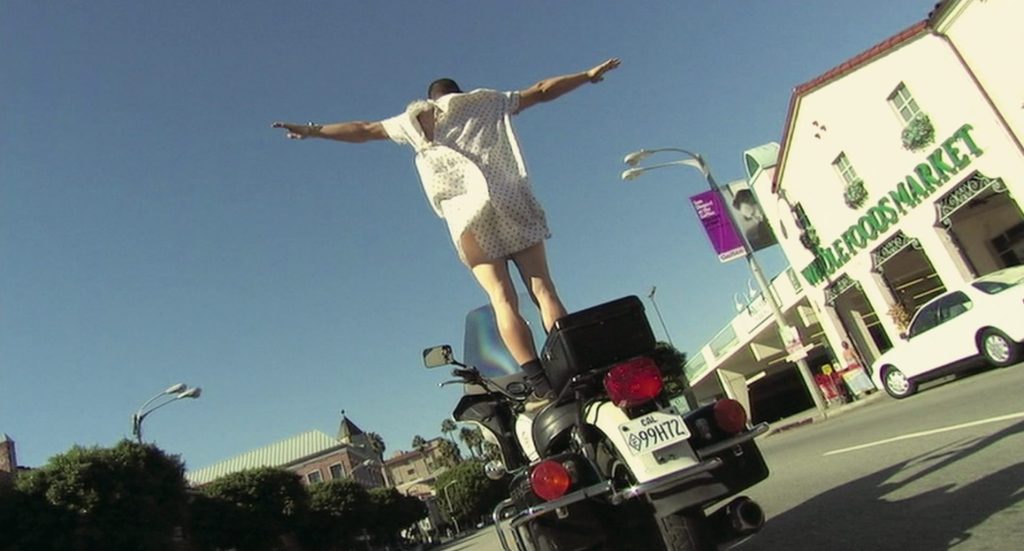
Palmer’s essay raised many interesting points in dialogue with Sobchak’s phenomenology. Upon my first exposure, I felt that my understanding of the cinesthetic subject was limited to a kind of carnal recognition from cinematic stimuli, where our bodies respond to the movement of its likeness on screen. After reading the article, however, I realize that there are several larger implications that this phenomenological focus allows, specifically in its inquiry into the chiasmatic relation between language and embodiment, and the solution provided by acknowledging the productive use of catachresis to fill this gap. One thing that both Sobchak and Palmer cite as evidence for their theories are excerpts from film reviews. I found this curious, as our canonical theorists tended to situate their logical reasoning within other, more reified schools of thought, such as psychoanalysis and semiotics.
Palmer’s claim of immediacy and hypermediacy in Crank (Neveldine/Taylor, 2006) as modes of hypermasculine cultural production can only be salient if spectatorship is shown to engage with the text’s manipulation of speed, thus endorsing its establishment of machinery as an interpellation of the masculine. The most direct form of evidence for the film’s reception lies in no clearer location than in written reviews. Similarly, Sobchak’s claim of the synesthetic and coenesthetic carnal intelligence of film experience can only sustain credence through her ability to establish evidence through somatic cinematic accounts. This is equally apparent in Sobchak’s evocation of personal anecdotes, such as her experience with The Piano (Campion, 1993), and the alternative film review of Toy Story (Lasseter, 1995). It seems, then, that spectator feedback, and their articulation of such through language, are as critical a source of evidence as theories borrowed from other disciplines. However, the dubiousness of the reviewer and bias in selection may weaken the theory by inviting skepticism.
One additional thread worth noting is the post-human argument that spans from Sobchak’s to Palmer’s writing. The argument suggests that if immediacy and hypermediacy in Crank are used to demonstrate machinery as an interpellation of the hypermasculine, then perhaps phenomenological cinesthesia for the masculine is represented as a cinesthetic empathy with the machinery — specifically in the film’s deployment of speed as its formal manifestation. This can be particularly supported by the repeated point-of-view shots from either the perspective of the fridge at the convenience store, the gas pedal beneath Chelios’ foot, or the microwave in Eve’s apartment. What can be said about our carnal intelligence of the microwave, prefigured by seeing the characters from inside it and experiencing its/our buttons being pushed? Perhaps this is the “intensional” phenomenon that Sobchak speaks of: “the commingling of flesh and consciousness, the human and technological sensorium, so that meaning and where it is made do not have a discrete origin in either bodies or representation but emerge from both”. The machinery of the cinematic apparatus, then, is an interpellation of our lived bodies, as seen in Neveldine/Taylor’s distinct use of the handheld camera. Our lived bodies are also an interpellation of the cinematic apparatus, as evidenced by our cinesthetic coherence, which operate as an extension of the exhibitive mechanism.
 Jenn Thảo Nguyễn
Leave a comment