
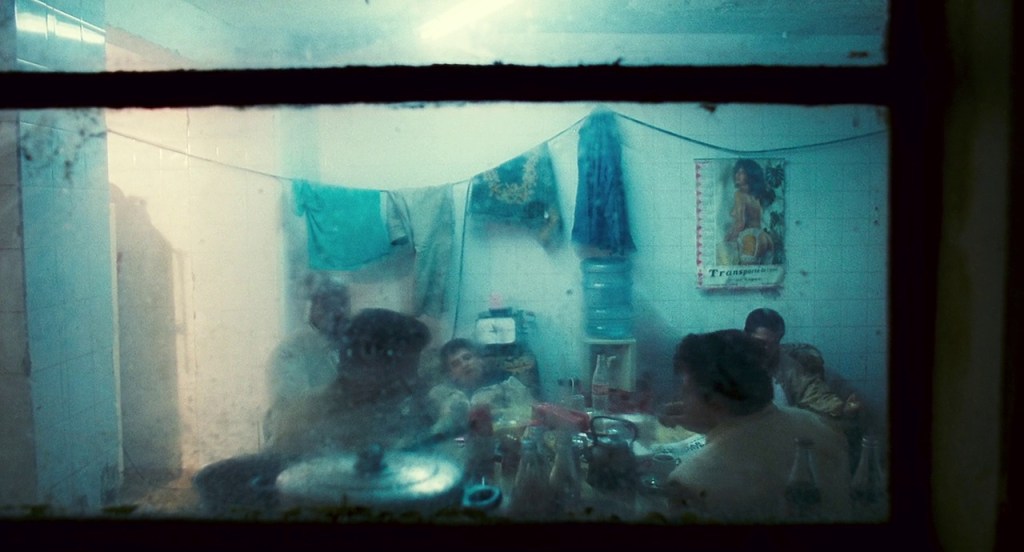
From the several theories analogous to either frame or window, presented within Cinema as Window and Frame — alongside our closer looks as Arnheim and Kracauer in Critical Visions — I began to feel a tension being drawn between forced perspective and calculated coercion of the audience’s engagement with films. Arnheim’s moderate Gestalt theory sits at the center of the table, accompanied by the Constructivists, flanked by Eisenstein’s Pavlovian montage and Bazin’s minimally-mediated ontological wholeness. The question that this dialogue begs, perhaps, is one of ethics. Is it impressive that something is able to masterfully reproduce and anticipate your manufactured response to a series of conflicting images, or is it shameful and must require terms and conditions?
This paradox is highlighted by Elsaesser & Hagener’s (E&H) explanation of Classical Hollywood Cinema’s (CHC) codified rules, designed to justify their chronic presence in the film’s storytelling by desensitizing viewers to it through technique. Transparency (window) is the frame with which you view this filmic world, and perhaps performative transparency—as practiced in CHC—is the frame with which we often view the real world. If the window (Transparency) is indeed the frame, what can one see when one cannot yet see their participation in the event? To ask for consent in the cinematic world, and disclosure of the illusion of obscura, could perhaps be considered a divergence from reality as ontologically we are not provided the luxury of disclosure and consent in many other realms of our lives. We are alternatively often offered performative transparency, by way of disclaimers and false promises in our user agreements and social contracts, and therefore these calculated coercions of the screen force us to the truest perspective on our lives and our realities. If this preliminary posit holds, it would thus render Eisenstein’s theory of montage, alongside CHC’s codified rules, perhaps the most realist approach and our cursory introduction to Bazin’s permutation of realism (through neorealist styles of film) something closer to that of a purist illusion. Although I do not believe that “the power of film lies only with its ability to represent reality” (CV 279), I do think that if we are observing Bazin in contrast to Eisenstein — within E&H’s application of Cinema as window and frame — this idea of what ‘reality’ is, is central to the dialogue and demands additional questioning only to the extent of what ‘realism’ is reached by each theorist.
 Jenn Thảo Nguyễn
Leave a comment